TL;DR: A portable hot rubber melter needs to balance enough capacity for a productive work session with a footprint that moves easily between setup points, fits through site access points, and does not require heavy equipment to reposition. A&A Melters’ compact air-jacketed units, from the HotPot and A-25 through the A-60 and A-110, are designed for exactly this: field-portable, elevator- and doorway-friendly, with propane standard across the line and diesel and electric options on select models. They heat up in approximately 20 minutes and protect the rubber from charring throughout the pour.
Hot rubber work moves. A waterproofing applicator on a multi-section rooftop relocates several times a day. A crew working a plaza deck shifts from bay to bay. A repair crew works one access point, then the next. In every case, the melter has to follow the work.
“Portable” in this context means something specific: a unit compact enough to position close to the work, move without dedicated lifting equipment, and navigate the access constraints of real job sites, not just “small enough to fit on a trailer.”
What makes a hot rubber melter truly portable?
- Compact footprint: small enough to maneuver in tight construction sites, through doorways, and in elevator cabs.
- Manageable weight: moveable without a forklift or crane when empty (or nearly so).
- Access-friendly dimensions: the benchmark is a 34-inch doorway (standard commercial door) and a standard elevator cab.
- Stable on uneven surfaces: wide stance, low center of gravity, and casters rated for outdoor and rough-terrain repositioning.
- Fast heat-up: a portable unit moved frequently cannot afford 45-minute heat-up delays. Every relocation becomes a waiting period if heat-up is slow.
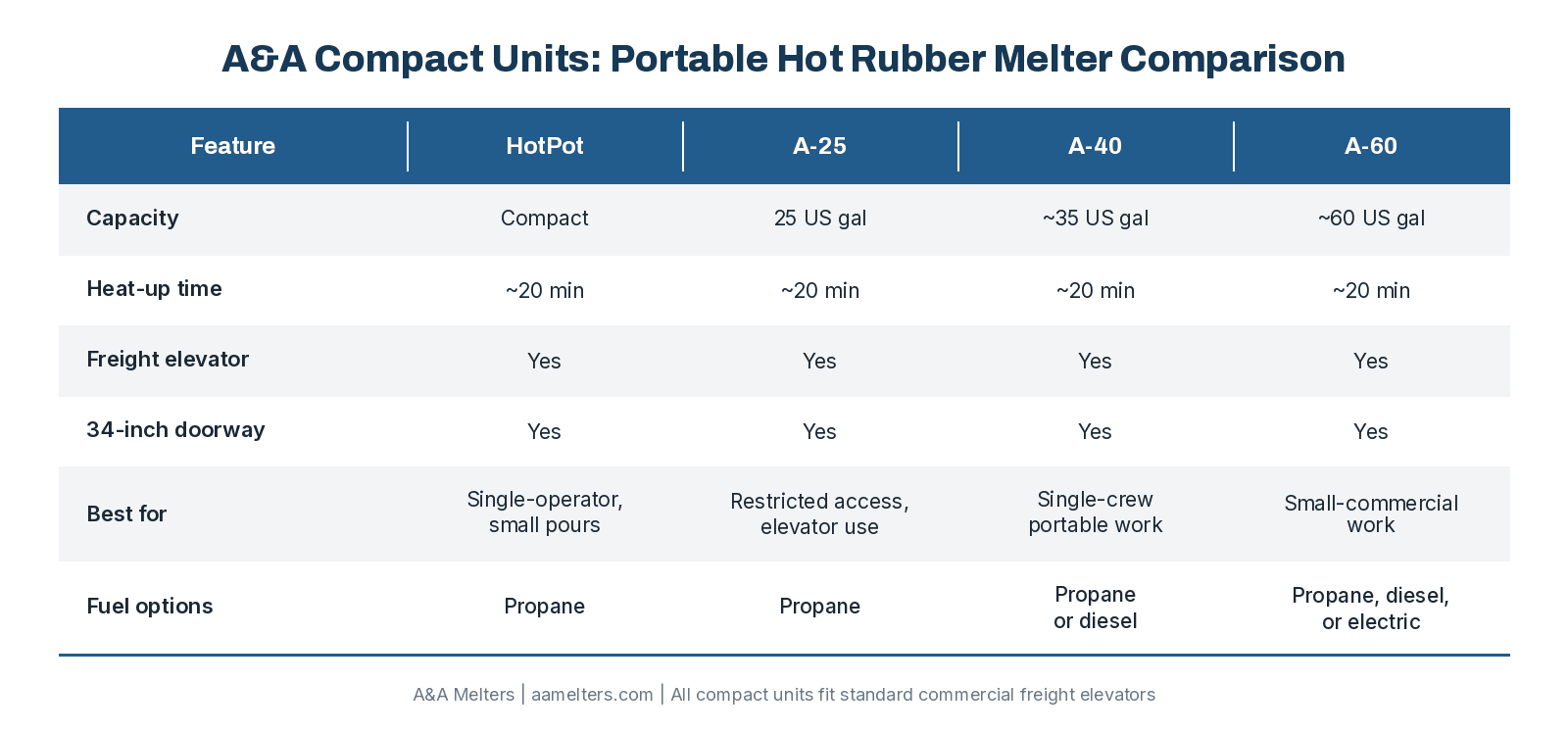
A&A Melters designs its compact line specifically around these constraints. The A-25 and A-40 are built to fit through 34-inch doorways and standard elevator cabs. The HotPot is the most compact unit in the range: designed for single-person portability on rooftop and interior waterproofing work.
Which A&A Melters unit is the most portable?
| Model | Capacity | Best for |
|---|---|---|
| HotPot | Compact | Single-operator, small pours, interior/rooftop |
| A-25 | 25 US gal | Restricted-access, elevator use, small crew |
| A-40 | ~35 US gal | Single-crew portable, 20-min warm-up, elevator-ready |
| A-60 | ~60 US gal | Versatile small-commercial work |
| A-110 | 110 US gal | Mid-size portable, available electric, indoor-capable |
The A-40 is the most popular compact unit for contractors who need true field portability without sacrificing a full working capacity. It goes from cold to pouring in approximately 20 minutes and fits through any standard doorway or elevator.
Is a portable melter still capable enough for real production work?
For single-crew hot rubber work, a 25–60 gallon kettle is appropriate. The math works: a 40-gallon unit producing two to three loads per day covers 80–120 gallons of material for a two-person crew, which is a full, productive working day on most waterproofing or repair jobs.
For higher-volume work on larger sections, stepping up to the A-110 (110 gallons) or A-210 still gives you a maneuverable unit while significantly increasing daily throughput.
The key is matching capacity to actual daily volume, not to an imagined worst-case need that rarely happens in practice.
What fuel option is best for portable work?
Propane is the default for outdoor portable work. Cylinders travel easily, propane is available everywhere, and a 40-pound cylinder gives a compact unit a full working day of heat.
Fuel availability varies by model. The HotPot and A-25 run on propane only. The A-40 is available in propane or diesel. The A-60 offers the full choice: propane, diesel, or electric.
Electric is the right choice for portable work inside buildings, parking garages, covered work areas, and rooftops in jurisdictions with combustion restrictions. A&A’s electric A-60 and A-110 deliver full air-jacketed performance without combustion. Electric units require a 480V 3-phase power supply, so confirm site power is in place before the crew mobilizes.
What else should you look for in a portable hot rubber melter?
- Agitation quality: even in a compact unit, the agitator must keep the material consistent through a full pour. A stalled or undersized agitator in a portable unit is a productivity killer.
- Caster design: four-caster rolling bases with lockable wheels and a low center of gravity for stable operation on grade.
- Safe setup practice: a stable burner shroud, a reachable manual burner and fuel shutoff, and a charged fire extinguisher within arm’s reach. A melter on an occupied site should never be left unattended at operating temperature.
- Parts availability: portable units take more mechanical stress from frequent movement. Confirm parts availability before purchasing.
A&A Melters has supported its compact line with parts and service since the late 1980s.
Frequently asked questions
What is the smallest hot rubber melter A&A makes? The HotPot is A&A Melters’ most compact unit, designed for single-operator interior and rooftop work. The A-25 is the smallest in the main product line at 25 US gallons.
Does a portable melter fit in a pickup truck bed? The compact A&A units (HotPot, A-25, A-40) are designed for pickup truck transport, either in the bed or on a small trailer. Confirm weight and dimensions against your truck’s payload rating before loading.
Can I use a portable melter on a rooftop? Yes. A&A’s compact units are designed for rooftop work. They fit through 34-inch doorways and standard elevator cabs, and compact dimensions make hoisting feasible where required.
How long does a portable hot rubber melter take to heat up? A&A’s compact air-jacketed units reach working temperature in approximately 20 minutes from cold. This is a significant advantage over oil-jacketed portable units of comparable size.
The portable unit that doesn’t slow you down
A portable hot rubber melter should be exactly that: portable enough to go where the work is, fast enough to not become the rate-limiting step, and capable enough to fuel a productive crew for a full day. A&A Melters’ compact line delivers all three.
Find the right portable unit for your work: request a quote or call 1-888-469-4480.