TL;DR: Hot-applied rubberized asphalt is one of the most reliable waterproofing methods for below-grade and at-grade concrete foundations. It bonds monolithically to the substrate, accommodates concrete movement, and resists water infiltration over decades. An air-jacketed hot rubber melter delivers this material to working temperature faster and more cleanly than oil-based alternatives, protecting the material’s integrity and reducing the risk of application defects. A&A Melters builds the equipment contractors and applicators rely on for this work.
Water infiltration through concrete foundations is one of the most costly and damaging building failures a property owner can face. Hot-applied rubberized asphalt waterproofing is a proven, high-performance solution, and the melter used to prepare and deliver that material is a critical factor in how well the system performs.
Here is what contractors need to know about using hot rubber melters for concrete foundation sealing.
Why is hot-applied rubberized asphalt used on concrete foundations?
Concrete is strong in compression but porous and subject to cracking from thermal cycling, settlement, and structural movement. Without waterproofing, water migrates through those pores and cracks, leading to moisture infiltration, reinforcement corrosion, and long-term structural degradation.
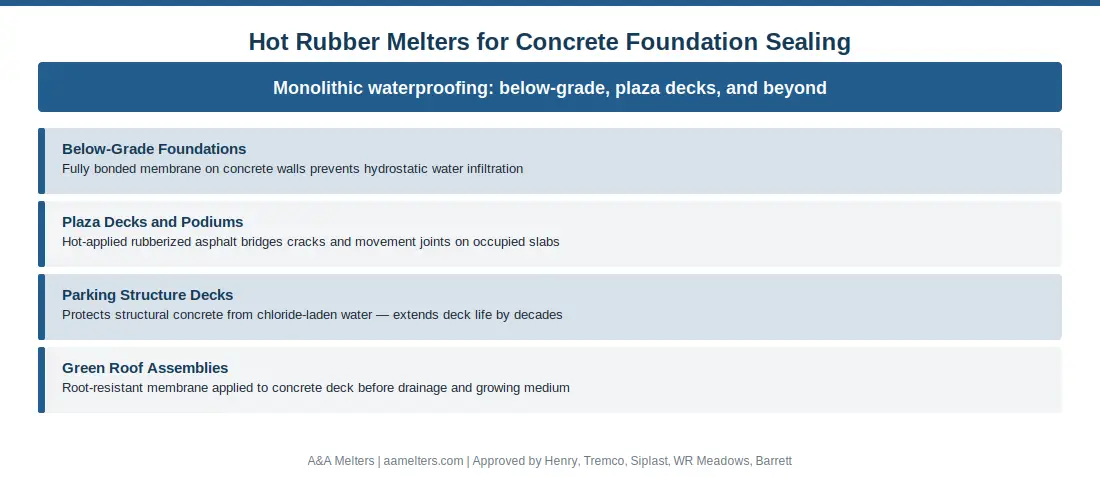
Hot-applied rubberized asphalt forms a seamless, monolithic membrane when properly applied. Unlike sheet membranes with seams, a hot-applied system has no joints to fail. The rubberized asphalt bonds directly to the concrete substrate, is flexible enough to bridge small cracks and accommodate normal concrete movement, and cures quickly to a stable waterproofing layer.
Major material manufacturers, including Henry, Tremco, Siplast, W.R. Meadows, and Barrett, produce hot-applied rubberized asphalt products specifically formulated for below-grade and at-grade foundation waterproofing. These products require a properly functioning melter to maintain material temperature within the manufacturer’s application window.
What role does the melter play in foundation waterproofing quality?
The melter is not just the heating vessel. It determines the temperature, consistency, and quality of the material at the point of application. Three melter factors directly affect the outcome on the foundation:
Temperature control. Hot-applied rubberized asphalt has a defined application temperature window specified by the material manufacturer. Too cool and the material will not bond or flow correctly. Too hot and the material chars, breaking down the polymer structure that provides elongation and flexibility in the cured membrane. An air-jacketed melter with precise temperature control keeps material within that window reliably.
Material integrity. An air-jacketed design heats indirectly, so the material never contacts a direct flame or an overheated oil surface. A&A’s stainless steel fire tubes protect against hot spots. The result is material that arrives at the substrate with its full performance properties intact.
Consistency across the pour. The agitation system in a properly functioning melter keeps the material blended and at a consistent temperature throughout the kettle. Poor agitation allows temperature stratification and partial degradation.
What size melter do you need for foundation waterproofing?
Foundation waterproofing projects vary widely in scale: a residential below-grade foundation might require 40–80 gallons per application day, while a large commercial project (plaza deck, parking structure, bridge abutment) can require several hundred gallons.
| Project type | Suggested melter capacity |
|---|---|
| Residential below-grade foundation | 25–60 US gallons |
| Small commercial/ICI below-grade | 60–150 US gallons |
| Large commercial, plaza deck | 150–300 US gallons |
| Major infrastructure, parking structure | 250–500 US gallons |
A&A Melters’ compact units (A-25, A-40) are designed for residential and light commercial work where site access is restricted and a full-size rig cannot be mobilized. The A-60 through A-210 serve the mainstream commercial waterproofing contractor.
What are the access challenges for foundation work, and how does equipment design help?
Below-grade foundation waterproofing often happens in tight site conditions: excavation perimeters, basement entrances, under-bridge areas, and construction sites with limited vehicle access. The melter needs to fit through available openings and be maneuverable without a full-size truck.
- The A-25 and A-40 are portable enough to be positioned close to the work face.
- Compact units fit through 34-inch doorways and standard elevators for in-building work.
- Caster options allow repositioning on grade without mechanical assistance.
For at-grade plaza deck and above-grade waterproofing applications, units must often be hoisted to the working level. Compact units designed with appropriate lift points and weight ratings make this feasible.
What fuel option is best for foundation waterproofing?
Propane is the most common choice for open-site foundation work. It is clean-burning, widely available, and effective in a range of temperatures.
Electric is the right choice for enclosed or partially enclosed foundation work (basement waterproofing inside an existing structure, underground parking, confined trench work) where combustion equipment is not permitted or where fume management is a concern. A&A’s electric models deliver the same performance without combustion, with precise temperature control suited to the material manufacturer’s application window.
How does hot-applied rubberized asphalt compare to other foundation waterproofing methods?
| Method | Seams | Movement accommodation | Application speed | Long-term performance |
|---|---|---|---|---|
| Hot-applied rubberized asphalt | None (seamless) | High (flexible) | Fast (hot pour) | Excellent |
| Sheet membrane | Seams at overlaps | Moderate | Moderate | Good (seam-dependent) |
| Cold-applied liquid | None | Moderate | Slow (cure time) | Variable |
| Crystalline coatings | None | Low | Moderate | Good (limited) |
Hot-applied rubberized asphalt’s combination of seamlessness, flexibility, and bond strength makes it a preferred specification for high-performance foundation waterproofing in commercial and institutional construction.
Frequently asked questions
Can I use hot-applied rubberized asphalt on cured and existing concrete? Yes. Hot-applied rubberized asphalt is commonly applied to both new and existing concrete foundations as part of waterproofing repairs and upgrades. Surface preparation (cleaning, crack repair, priming where specified by the material manufacturer) is critical to adhesion.
Do I need a specific primer before applying hot rubber to concrete? Many hot-applied rubberized asphalt products require a concrete primer to improve adhesion. Follow the material manufacturer’s specific application instructions. A&A Melters equipment is approved by major material manufacturers; use the material’s own installation guide for preparation requirements.
Is hot-applied rubberized asphalt suitable for below-grade waterproofing? Yes. Below-grade waterproofing is one of the primary applications for hot-applied rubberized asphalt. Products formulated for this application are resistant to hydrostatic pressure and soil contact. Confirm material selection with the manufacturer or specifying engineer.
What temperature should hot rubber be applied at on concrete foundations? Application temperature is specified by the material manufacturer and varies by product. Typically, the range is between 350°F and 450°F (177°C and 232°C). Confirm the recommended temperature window for your specific product and maintain it throughout the pour.
Get the application right from the start
A hot-applied rubberized asphalt waterproofing system is only as good as the conditions under which it was applied. That starts with the melter: one that heats the material to the right temperature, maintains it without charring, and gives your crew the consistency they need to apply a defect-free membrane.
A&A Melters builds air-jacketed hot rubber equipment approved by the material manufacturers whose products go into these systems.
Talk to the A&A team about the right unit for your foundation waterproofing work: request a quote or call 1-888-469-4480.