TL;DR: Hot-applied rubberized asphalt is the right material for parking lot crack sealing and repair: it bonds tightly, stays flexible through freeze-thaw cycles, and lasts significantly longer than cold-pour alternatives. The melter used to prepare that material determines how fast your crew moves, how well the material performs, and how much of the morning you spend waiting for heat-up. An air-jacketed melter heats up to 5x faster than oil-based units, delivers material without charring, and gets your crew to work sooner.
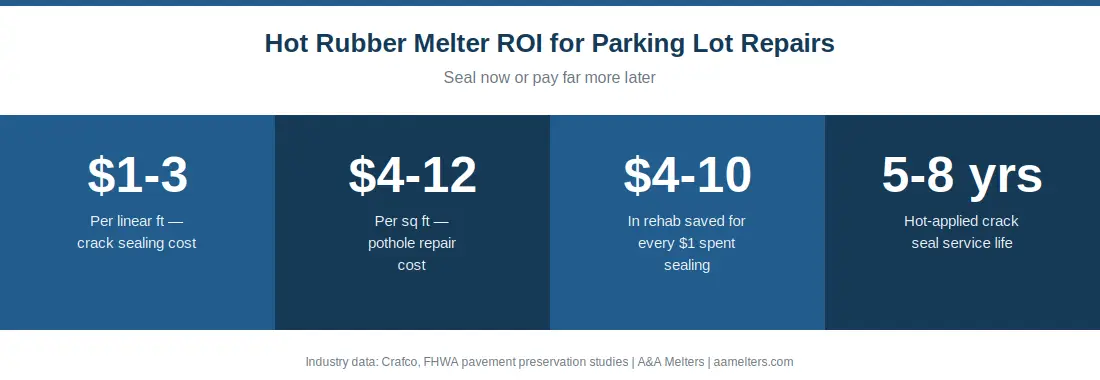
Parking lots deteriorate faster than most people expect. Traffic loads, UV exposure, and seasonal freeze-thaw cycles stress the pavement continuously, producing cracks that, if left untreated, lead to potholes, base failure, and the expensive prospect of full resurfacing. Industry studies consistently show that every $1 spent on preventive crack sealing saves $4 to $10 in future rehabilitation costs. That math makes a well-equipped crack sealing operation one of the most profitable services in a contractor’s portfolio.
Here is how a hot rubber melter earns its place in parking lot repair work.
Why is hot-applied rubberized asphalt better than cold-pour for parking lots?
Cold-pour crack fillers are inexpensive and require no equipment beyond a bottle or tube. For hairline cracks on low-traffic surfaces, they have a place. For working cracks in commercial parking lots, they do not.
- Bond strength: Hot-applied material flows into and adheres to the crack walls, forming a true mechanical and chemical bond. Cold-pour sealants sit in the crack rather than bonding to it.
- Flexibility: The rubber polymers in hot-applied material allow the seal to flex with the pavement through thermal expansion and contraction, without pulling away from the crack walls.
- Service life: A properly installed hot-applied seal typically lasts 3 to 5 years in commercial parking conditions, compared to 1 to 2 years for most cold-pour products.
- High-traffic durability: Hot-applied material, once cured, withstands vehicle loads without displacement. Cold-pour products are frequently pushed out of working cracks under traffic.
The tradeoff is that hot-applied work requires a melter. For contractors who have that equipment, it is a significant competitive advantage in both quality and margin.
How does an air-jacketed melter improve parking lot repair productivity?
Parking lot crack sealing is a throughput game. The faster the crew moves across the lot, the lower the per-linear-foot cost and the higher the margin. The melter is the rate-limiting step if it is slow to heat up or requires constant temperature babysitting.
Faster heat-up. A&A’s air-jacketed design heats up to 5x faster than comparable oil-based melters. Compact units are ready in approximately 20 minutes from cold. That means the crew is pouring, and billing, sooner every morning and after every setup move.
Consistent material temperature. The air jacket distributes heat evenly around the kettle, maintaining a consistent material temperature without the stratification that can occur in poorly agitated or direct-fired equipment. Consistent temperature means consistent material flow and consistent seal quality.
No charring. An overheated or direct-fired melter can scorch the material. Charred rubber has degraded polymer structure and reduced flexibility, leading to seals that crack and pull away prematurely. Air-jacketed indirect heating prevents this.
What melter capacity is right for parking lot repair work?
| Job type and daily production | Suggested melter capacity |
|---|---|
| Small commercial lot, 1-crew | 60–110 US gallons |
| Standard commercial/municipal lot, 2-crew | 110–210 US gallons |
| High-volume lot sealing or multi-lot days | 210–380 US gallons |
A&A Melters’ A-110 is a popular choice for commercial parking lot work: versatile enough for standard lots, compact enough for a single truck setup, and available in propane, diesel, or electric. The A-210 handles higher daily volume without requiring a larger crew.
What about mastic for pothole and larger repair work?
Crack sealing addresses linear surface cracks. Parking lot repair often also requires patching: potholes, alligator cracks, utility cut repairs, and joint failures that need more material volume and structural support than a sealant provides.
For this work, a mastic melter or a standard hot rubber melter with a mastic-rated configuration handles the thicker, aggregate-filled repair compounds used for structural patches. A&A Melters produces units capable of running mastic materials for contractors whose parking lot work includes patching alongside sealing.
How quickly does a parking lot need crack sealing?
According to pavement preservation research, cracks sealed within the first 3 years of a pavement’s life have the highest return on investment. Beyond that window, the surrounding pavement has typically begun deteriorating, and sealing extends life but returns less per dollar than early intervention.
For contractors, this means the sales conversation is always a time-sensitive one: delay costs the client money. Your equipment’s reliability and speed are part of the value proposition you bring to that conversation.
Frequently asked questions
What temperature should hot rubber be for parking lot crack sealing? Application temperature varies by material. Most hot-applied crack sealants specify a working temperature between 350°F and 430°F (177°C to 221°C). Follow the material manufacturer’s application instructions for your specific product.
How long does hot-applied crack sealing last in a commercial parking lot? A properly installed hot-applied rubberized asphalt seal in a commercial parking lot typically lasts 3 to 5 years under normal traffic conditions. Service life depends on crack width, pavement condition, traffic volume, and climate.
Can I use the same melter for crack sealing and waterproofing? Yes. A&A Melters’ product line is designed for both pavement crack sealing and roofing/waterproofing applications. Confirm material compatibility with your material manufacturer.
What is the best time of year for parking lot crack sealing? Spring and fall are generally optimal: temperatures above 40°F (4°C) for application, dry pavement, and cracks open to their widest point in cool weather. Hot summer asphalt can expand cracks closed, and frozen winter pavement does not accept material properly.
Do I need to rout cracks before sealing? Routing (widening and squaring the crack) improves the reservoir for material, increases bond surface area, and extends seal life. It is standard practice for commercial-grade crack sealing. Consult the material manufacturer’s specifications for your product.
The equipment that keeps your crew profitable
For parking lot repair contractors, the hot rubber melter is a direct contributor to profit margin. A machine that starts fast, holds temperature accurately, and delivers clean material without charring keeps your crew at full productivity across the season.
A&A Melters builds air-jacketed hot rubber melters designed for exactly this work, from the compact A-60 to the high-volume A-380, in propane, diesel, and electric.
Find the right unit for your parking lot work: request a quote or call 1-888-469-4480.