TL;DR: Air-jacketed and oil-jacketed mastic melters both heat aggregate-filled repair compounds, but they do it differently, and the differences matter on every job. Air-jacketed designs heat up to 5x faster and eliminate the heat-transfer oil that oil-jacketed units require. Oil-jacketed melters are widely available and work, but carry a higher daily maintenance load and slower start times. For contractors who value productivity, air-jacketed is the stronger choice.
If you are in the market for a mastic melter, you will quickly find that not all units heat the same way. The two dominant heating designs are air-jacketed and oil-jacketed, and choosing between them is the most important technical decision you will make before you buy.
This comparison covers everything you need to know to make that decision confidently.
How does an air-jacketed mastic melter work?
An air-jacketed melter uses a double-walled kettle design. Burners heat the space between the outer shell and the inner kettle, filling that space with hot air. The hot air then heats the material inside the kettle indirectly: no oil, no direct flame contact with the mastic.
A&A Melters has built air-jacketed mastic-capable equipment since the late 1980s, with stainless steel fire tubes standard.
How does an oil-jacketed mastic melter work?
An oil-jacketed melter uses a heat-transfer oil to fill the space between the outer shell and the inner kettle. Burners heat the oil, and the oil transfers heat to the mastic. Oil-jacketed designs provide more even heat distribution than an open flame, but the oil bath adds thermal mass that must be heated before the mastic begins to warm, making heat-up slower than an air-jacketed system.
Heating speed: how significant is the difference?
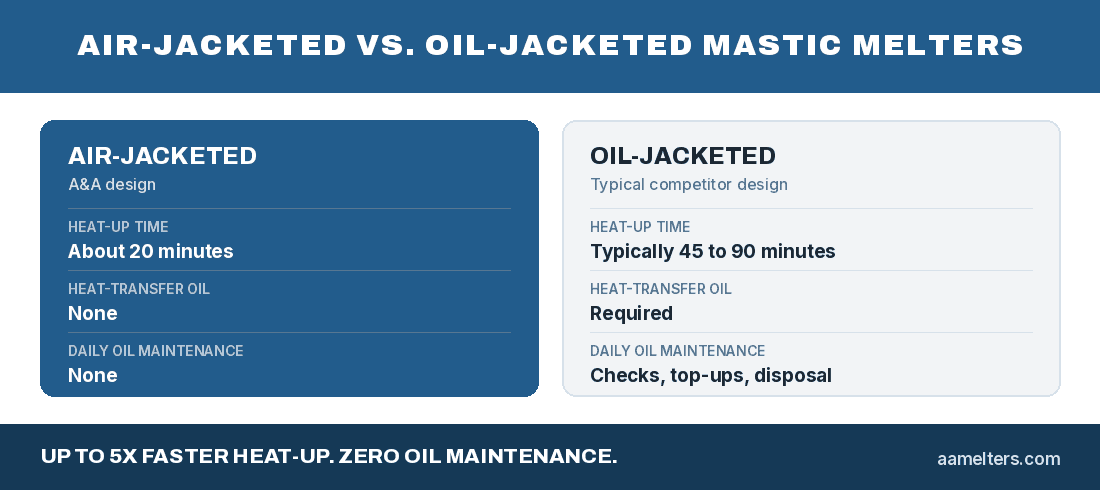
| Heating design | Compact unit heat-up time |
|---|---|
| Air-jacketed (A&A design) | Approximately 20 minutes |
| Oil-jacketed (typical) | Typically 45–90 minutes |
A&A Melters’ air-jacketed design heats up to 5x faster than comparable oil-based melters. That difference adds up to a meaningful number of productive hours across a season.
Maintenance: what does each design require?
| Maintenance task | Air-jacketed | Oil-jacketed |
|---|---|---|
| Pre-use oil level check | Not required | Required |
| Oil top-up | Not required | As needed |
| Oil degradation monitoring | Not required | Periodic testing recommended |
| Annual oil change | Not required | Typically required |
| Oil disposal | Not required | Required |
Cost comparison: purchase price vs. total cost of ownership
- Heat-up time value: at 30 minutes of additional daily heat-up time per shift, 150 shifts per year, and a conservative $50/hour crew cost, the oil-jacketed unit’s heat-up delay costs approximately $3,750 per year in unproductive crew time alone.
- Oil maintenance cost: heat-transfer oil, annual oil changes, and disposal add several hundred dollars per year in direct cost.
Over five years, these costs exceed the typical purchase price premium for an air-jacketed design several times over.
Frequently asked questions
Can I convert an oil-jacketed melter to air-jacketed? No. The two designs require fundamentally different kettle and shell construction. Conversion is not practical or cost-effective.
Do material manufacturers specify which type of melter to use? Many do. A&A Melters is approved by major material manufacturers for use with their products. Always confirm the material manufacturer’s equipment recommendations for the specific product you are using.
The clear choice for productive mastic work
Air-jacketed design wins on the operational dimensions that matter most to a contractor: faster heat-up and lower maintenance. A&A Melters builds air-jacketed equipment for mastic, hot rubber, and crack sealing work for roofing, waterproofing, and pavement contractors across North America.
Ready to upgrade your mastic melter? Request a quote or call 1-888-469-4480.