TL;DR: An air-jacketed hot rubberized asphalt melter uses indirect hot-air heating instead of an oil bath to bring rubber to working temperature. The result is heat-up times up to 5x faster than traditional oil-based melters, zero charring of the material, and an oil-free design that cuts maintenance and simplifies daily operation. For roofing, waterproofing, and pavement crews who can’t afford slow starts or burnt product, it is the most productive choice on the job site.
Every hot rubber job starts the same way: waiting on the melter. How long that wait lasts, and whether the material comes out right at the other end, depends almost entirely on the heating technology inside the machine.
Air-jacketed hot rubberized asphalt melters take a fundamentally different approach to that problem. Here is what that means for your crew, your material, and your mornings.
What is an air-jacketed hot rubberized asphalt melter?
An air-jacketed melter is a double-walled kettle that circulates hot air between the outer shell and the inner chamber, heating the rubber indirectly. The material never makes direct contact with a flame or a scorching oil bath. Instead, clean, uniform heat surrounds the kettle and brings the rubber to working temperature steadily and evenly.
The design eliminates the heat-transfer oil entirely. The air jacket is self-contained, and the burner system heats the air directly. The result is faster, cleaner heating with no oil to fill, monitor, or drain between jobs.
How does air-jacketed heating compare to oil-jacketed heating?
In an oil-jacketed melter, a heat-transfer oil fills the space between the outer shell and the inner kettle. Burners heat the oil, and the oil then heats the material. It works, but it adds an extra thermal step, an oil supply to maintain, and a maintenance burden that costs money across a season.
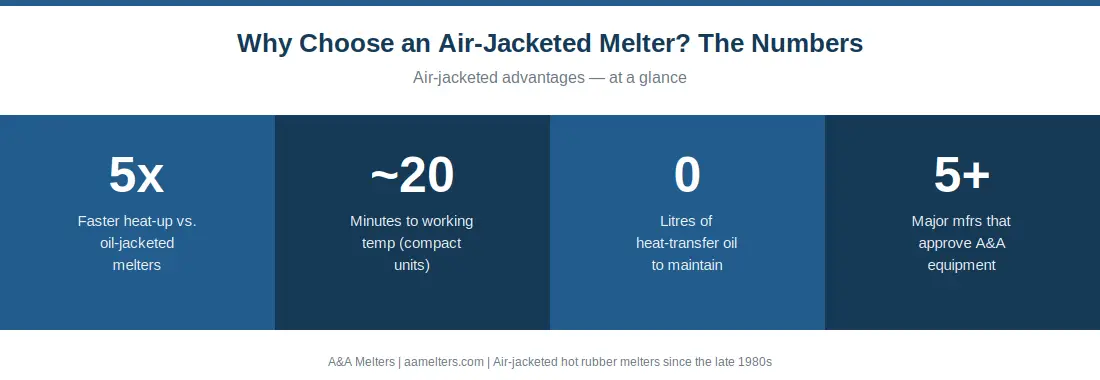
An air-jacketed design removes that layer entirely. Because there is less thermal mass to heat and the transfer is direct-to-air, the kettle reaches working temperature significantly faster. A&A Melters’ air-jacketed designs heat up to 5x faster than comparable oil-based melters. Compact units like the A-40 and HotPot are job-ready in approximately 20 minutes from a cold start.
Over a full season, that speed difference translates into a meaningful number of additional billable hours.
Why does heat-up speed matter so much to contractors?
Every minute the melter is cold, the crew is not billing. On a commercial roofing job or a road-repair contract with multiple daily starts and relocated setups, cold-start delays compound into thousands of dollars of lost production across a season.
The faster heat-up also gives crews flexibility that oil-jacketed equipment does not. Short moves between setup points, lunch relights, and unexpected delays all cost far less when recovery time is measured in minutes rather than half-hours.
How does air-jacketed heating protect the material?
Hot rubber is engineered to a specific performance standard. Charring, the degradation that occurs when rubber scorches against a direct heat source or an overheated oil bath, reduces that performance, leads to membrane failures, increases material waste, and can generate rework costs that far exceed the value of the batch.
Because an air-jacketed melter heats indirectly and evenly, the material stays within the safe application window without hot spots. A&A’s stainless steel fire tubes add another layer of protection against scorching. The rubber coming out of the kettle is the same product the material manufacturer tested and approved.
This is why ALL major material manufacturers, including those whose products are used in roofing, waterproofing, plaza deck, and pavement applications, approve A&A Melters equipment for use with their hot-applied products.
What maintenance does an oil-less design save you?
An oil-jacketed melter requires the heat-transfer oil to be filled before use, monitored during operation, and eventually replaced as it degrades. On a job site, that means extra supplies, extra time at start-up and shutdown, and a maintenance interval that interrupts the equipment’s working life.
An oil-less air-jacketed melter has none of those requirements. The air jacket is self-contained. Routine maintenance focuses on the kettle, the burner system, and the agitation components, not on a fluid management system running in the background. For contractors running melters across multiple sites or storing equipment over winter, this simplification adds up.
Is an air-jacketed rubberized asphalt melter right for your application?
Air-jacketed melters are purpose-built for hot-applied rubberized asphalt: the roofing, waterproofing, and pavement applications where both material integrity and job-site speed matter.
They work well for:
- Roofing and waterproofing: plaza decks, green roofs, parking structures, built-up roofing (BUR), and modified bitumen applications where heating precision protects the membrane.
- Pavement and crack sealing: road maintenance and parking lot preservation where throughput and rapid heat-up translate directly to job profitability.
- Restricted-site work: compact units (A-25, A-40, A-60) fit standard elevators and pass through 34-inch doorways. Electric configurations operate without combustion for indoor and rooftop sites where gas-fired equipment is not permitted.
The global hot-applied rubberized asphalt membrane market was valued at approximately $2.1 billion in 2024 and is projected to reach $3.4 billion by 2033, according to market research firm Data Horizzon Research. Demand for faster, more reliable application equipment grows alongside it.
Frequently asked questions
What size air-jacketed melter do I need? Capacity depends on your pour rate and job size. A&A Melters produces air-jacketed units from 25 to 500 US gallons, covering compact single-crew jobs through high-volume commercial contracts. The A-25 and A-40 suit portable and restricted-access work. The A-210, A-380, and A-500 serve high-output commercial and road applications. See the complete product range for specifications.
Do air-jacketed melters work with all rubberized asphalt materials? A&A Melters equipment is approved by major material manufacturers for use with their hot-applied products. The materials most commonly specified for roofing, waterproofing, and pavement crack sealing are designed to run in A&A equipment. Always confirm the material manufacturer’s equipment recommendations for your specific product.
What fuel options are available? A&A Melters builds air-jacketed units in propane, diesel, and electric configurations. The electric option is designed for indoor, rooftop, and other restricted-combustion sites.
How long has A&A Melters been making air-jacketed equipment? A&A’s air-jacketed designs originate from the late 1980s. The company has been independently owned and operated since 2007 and has more than 1,000 units currently in operation across North America.
Is an air-jacketed melter more expensive to buy? Air-jacketed units carry a similar or modestly higher purchase price than comparable oil-jacketed equipment. Total cost of ownership typically favors air-jacketed equipment over time because of reduced maintenance requirements, faster heat-up (more productive hours), and less material waste from charring.
The bottom line
If you are choosing a hot rubberized asphalt melter, the heating technology inside it determines your morning start time, your material quality, and your maintenance workload. Air-jacketed, oil-less heating delivers faster heat-up, cleaner material, and a simpler machine, backed by 35 years of field-proven design and over 1,000 units in operation across North America.
A&A Melters builds air-jacketed hot rubber melters from 25 to 500 gallons, in propane, diesel, and electric, for roofing, waterproofing, and pavement crews across North America.
Ready to find the right unit for your job? Request a quote or call toll-free at 1-888-469-4480.